

Ripples on the Pond


Ripples on the Pond, the latest story in the Justinia Wright Private Investigator canon, is live on Amazon. It’s a short story and only 99¢.

Originally, I gave the story to my mailing list as a gift. After 3 years, I made some minor changes, re-titled the story, and now offer it to the public.

Harry discovers that the old lady who stood on the street corner, and from whom he bought flowers, was killed in a hit and run accident. He also learns she left him a sizable inheritance.

He decides to hire his sister, ace Minneapolis private eye, Justinia Wright, to find out who killed the Flower Lady.

I won’t tell you anymore, as I don’t want to spoil the story. I will say, it has all the elements that people love about the Justinia Wright mysteries.

It has the warm, cosy atmosphere of a place you just want to be.

It has humor threaded throughout a fun and often tense story.

There’s good food, good wine, and good music. What more do you want out of a story?

I know thrillers are all the rage. Books where the pages turn themselves. I’ll be honest here. After a long day, the last thing I want are thrills and excitement.

I want to relax. I want to go to a place that feels like home. And if there is excitement, I want it to grow naturally out of what’s going on in the story. Not impossible stuff that smacks me in the face from page one.

So, if you want to go to a place where you can take your shoes off, and sit in your easy chair by the fire — then the adventures Tina and Harry find themselves in are right for you. Mysteries told in the British tradition, but set in contemporary Minneapolis, Minnesota. America’s Northland.

Comments are always welcome. And until next time, happy reading!

Share This!
Facebooktwitterpinterest

Tony Price: Confidential

Richard Schwindt’s monster hunting social worker, Tony Price, is one of the most recent additions to the ranks of the occult detective.

He features in 4 novellas:

Scarborough: Confidential

Sioux Lookout: Confidential

Kingston: Confidential

Ottawa: Confidential

The first 3 were collected in Tony Price: Confidential. The fourth novella is a prequel that takes place in Tony’s college days, where he discovers his gift for detecting evil.

Readers of this blog know I’m a big fan of Schwindt’s fiction, and his satires. His writing has gravitas, yet can be tongue in cheek. It is serious, yet laced with humor. It is often weird and spooky and over the top, yet he never loses you. You willingly continue to suspend disbelief, because you just have to see what happens next.

And the Tony Price stories are no different. Monster hunting was never so scary — or so fun.

We read non-fiction to be informed, to learn something. We read fiction primarily to be entertained. To lose ourselves in something not of our humdrum lives. Fiction is escapist entertainment. A good book takes us out of our everyday routine and plunks us down in another world.

Sure, we know we are reading a story, something somebody made up. It is the storyteller’s job to make us think otherwise. To help us make believe the story is true.

Richard Schwindt excels at the art of make believe. The Scarborough, the Sioux Lookout, the Kingston, the Ottawa of Mr Schwindt, while real places, are not the places of this reality. They are make believe.

Yet when he weaves his magic, we willing believe that his made up world is the real world. That is the artistry of a master storyteller at work.

Do you want to fight monsters? Do you want to beat supernatural bullies and make the playground of our world safe again?

Then join forces with Tony Price — monster buster extraordinaire.

Comments are always welcome. And until next time, happy reading!

Share This!
Facebooktwitterpinterest

The Ghostbusting Duo

There’s nothing better than reading a mystery that has a ghost or a monster in it. And that’s essentially what the occult detective genre is. A fusion of the traditional detective whodunit and the horror story.

Now, I will admit my description is a bit of an oversimplification. But for now, let’s run with it.

The prince, if not the king, of the ghostbusters is undoubtedly Jules de Grandin. Only Thomas Carnacki is perhaps more well-known.

Carnacki was the creation William Hope Hodgson. And Carnacki pastiches are almost as numerous as those of Sherlock Holmes. I’ll talk about Carnacki in another post.

Jules de Grandin and his “Watson”, Dr Trowbridge, were the creation of Seabury Quinn. They appeared in 92 stories and 1 novel, in the pages of Weird Tales magazine. From 1925 to 1951, the exploits of this dynamic duo thrilled readers of the Unique Magazine like no other.

GW Thomas, on his now defunct website, archived here, summarized de Grandin in this way:

Jules de Grandin is the master of the outrageous detective genre. Everything about him is over-the-top from his Hercule Poirot moustache to his outbursts of stilted French. De Grandin and his Watson-like companion, Dr. Trowbridge, live in Harrisonville, NJ, a town haunted by monsters, mad scientists and all manner of weird phenomena. As with Carnacki, not all of de Grandin’s adversaries were supernatural. The de Grandin stories appeared only in Weird Tales, where they were the most popular of all characters, beating even Conan the Cimmerian and Lovecraft’s Cthulhu Mythos.

From what I’ve read, Mr Thomas was spot on. Of all the writers who contributed to Weird Tales, Seabury Quinn was the most popular and, as a result, was paid at a higher rate.

Of all the characters to appear in WT, de Grandin was the most popular. And it was the promise of a serialized Jules de Grandin novel that held off the debt holders from shutting the magazine down in 1931.

Seabury Quinn and Jules de Grandin dominated Weird Tales. Quinn’s only real challenger was Allison V Harding in the 1940s.

Yet, Quinn was unfairly maligned and minimized by the Lovecraft Circle (because HPL didn’t like Quinn’s style and perhaps the fact that he wrote for money) and it has only been within the last dozen or so years that Quinn has come under reassessment. And I’m glad he has, because he was a good writer and should not be forgotten.

What I find interesting is that for all of de Grandin’s popularity, he was the product of having to meet a deadline. Quinn, himself, wrote:

One evening in 1925 I was at that state that every writer knows and dreads; a story was due my publisher, and there didn’t seem to be a plot in the world.  Accordingly, with nothing particular in mind, I picked up my pen and — literally making it up as I went along — wrote the first story which appears in this book.

I don’t know what collection of stories GW Thomas got that quote from, but I find it simply delightful. Necessity is indeed the mother of invention.

I own the 5 volume Nightshade Books edition of The Complete Tales of Jules de Grandin. You can, of course, find them on Amazon.

I’ve read over a dozen of the stories and I like them. The fun quotient is high and each story will give you an enchanting hour’s worth of entertainment. What more can you ask from a story?

Should you begin reading the de Grandin tales, and I encourage you to do so, keep in mind they were written for a monthly or bimonthly magazine. The storylines are somewhat formulaic. Certainly written to an established pattern. But then, so were the tales of Sherlock Holmes’ exploits.

I would recommend not reading more than a couple stories at one sitting in order to keep their charm and appeal fresh. Plus, doing so, will give you many, many days and weeks of reading pleasure. And who doesn’t want that?

Seabury Quinn was a superb storyteller. He had over 500 publishing credits during his lifetime, and was himself a magazine editor.

Approaching Quinn as a reader, I can say that he delivers the goods. He succeeds in transporting me to another time and place, and provides the entertainment value I’m looking for.

Approaching Quinn as a writer, I sit at the feet of a master and learn the craft of how to tell a story so that it will move the reader.

Last Christmas, I read Quinn’s Roads (his classic Christmas tale) to my sister and nephew. So captivating was Quinn’s prose that my nephew, at one point, uttered an interjection of awe. If only all of us writers could have that happen!

The occult detective genre is rich with exciting and spooky and chilling stories. The exploits of Jules de Grandin and Dr Trowbridge deliver on all counts.

Comments are always welcome. And until next time, happy reading!

Share This!
Facebooktwitterpinterest

Suspension Of Disbelief

As readers we all know that when we pick up a novel or a short story, it’s a work of fiction. Something someone made up in order to entertain us.

In other words, we know it’s a story but choose to disregard that knowledge, and instead pretend it’s real.

Lawrence Block posited an interesting thought in his book Telling Lies for Fun & Profit:

But first is it not essential that the writer suspend his own disbelief? He more than anyone knows it’s just a story… To the extent that he visualizes it first, to the extent that he has the experience of his fiction himself before he puts it on paper for someone else, his work acquires an essential reality in his own eyes. He suspends his own disbelief and makes it easier for the reader to go and do likewise.

I hadn’t thought about suspension of disbelief this way before, but I’d have to say Block is on target.

When I think about my own stories and novels, they do indeed acquire an essential reality. The characters become alive and their story becomes real.

I know objectively that Pierce Mostyn and the OUP, Tina and Harry, Bill Arthur and the world of Rocheport, aren’t real. Yet, they are very much real to me. They have lives of their own, and I’m privileged to share their lives on occasion.

The more real my characters are to me, the more I transfer that reality to my writing, which in turn transfers that reality to the reader.

I can’t help but wonder if the books I read that I find boring and fail to enable me to suspend disbelief, are the ones that, in Anthony Trollope’s words, were written by writers telling a story, instead of having a story to tell?

In the first instance, a writer tells the story because he feels he has to. Maybe he needs to pay the rent. In the second, he has a story and it’s so amazing he just has to tell someone. The first is a case of manufacturing a story and selling it to the reader. The second is a case of receiving a story, as it were, and telling it.

When a story has captured a writer to such a degree that he has to tell it, that’s when I think the writer has suspended his own disbelief and thereby enables us to suspend ours.

Of course, subject matter, genre, the writer’s skill, the writer’s style, all come in to play and impact suspension of disbelief. There are some writers who I just can’t stand, yet others love their writing. It’s the beauty in the eye of the beholder thing.

Nevertheless, I’ve read books where the writer truly needed to hire a proofreader. Yet, I read on in spite of the textual interruptions, because the writer told his story so well. My suspension of disbelief weathered the interruptions.

Lawrence Block’s observation is something to think about, and one we writers need to take seriously.

If the story we are writing is just a story, how can we ask our readers to treat it as anything else? They may enjoy it, but will they remember it? Will they even finish reading it?

But if our story is reality to us, then there’s a much greater chance our readers will be suspending their disbelief right along with us.

You can get Mr. Block’s excellent book on Amazon.

Comments are always welcome. And until next time, happy reading!

Share This!
Facebooktwitterpinterest

The Occult Detective

Fear is one of our oldest emotions — if not the oldest. And fear of the unknown is one of our greatest fears.

I don’t know what I don’t know, and that lack of knowing scares us. It is primal, that fear of the unknown.

Fear, and playing on our fears, is the stock in trade of the writer of the macabre. Those spinners of stories that parade our fears before us and scare us to death — and we love it.

For all of our façade of sophistication, biologically speaking we are no different than our ancestors from 300,000 years ago. We may no longer be afraid of thunder and lightning, and we may have outgrown our fear of what’s under our beds — we are, however, still controlled by our fears.

Just look at the nightly news. Listen to David Muir’s tone of voice. He’s playing into our fears. And how often do we say, “I’m afraid…” — no matter the context?

Is it any wonder that the tale of terror, the horror story, has never lost its appeal with readers?

Of late, I’ve been reading in the Weird West and Occult Detective genres.

I grew up watching Westerns on TV, although I didn’t read any until recently. I suggest any writers reading this to pick up a few old Westerns and read them. You will quickly see how most genre fiction today is really a Western in disguise.

The Weird West, as the name suggests, infuses the old West with something weird. It could be ghosts, demons, mad scientists, monsters of one sort or another, just as long as it falls into the category of weird fiction.

The Weird West is a somewhat recent category. The earliest examples I’ve found date from the 1950s.

The Occult Detective, on the other hand, had its beginnings in mid-1800s, and picked up steam in the wake of the success of Sherlock Holmes.

Unfortunately, I haven’t been impressed with the Weird West stories I’ve been reading. They are either too weird, or they come off too campy.

On the other hand, the Occult Detective stories I’ve read have been quite good, on the whole.

For contemporary stories featuring occult detectives, I turn to the pages of Occult Detective Magazine. You can find their website here. They are the only publication totally devoted to the Occult Detective genre. It’s one super magazine, and I heartily recommend it.

Then there are the classics. Those occult detectives that began appearing in the 1890s and perhaps reached their peak in the 1940s and 1950s.

Flaxman Low probably started the subgenre, at least in the form that we know it today. He was the creation of E and H Heron. The stories are pretty good, although some readers might find them somewhat slow going. Ghosts: Being the Experiences of Flaxman Low is the only current edition I’ve found (both free and for purchase) that contains all of the stories. It is priced at present for less than $2, and that is a steal.

Thomas Carnacki, the creation of William Hope Hodgson, is perhaps the most famous of all occult detectives, and Carnacki pastiches abound. You can find the original stories at Carnacki the Ghost-Finder for free. Marcus L Rowland also provides a publishing history.

If you want the stories in book form, you can find them all in The House On Borderland And Other Mysterious Places, which is volume 2 of The Collected Fiction of William Hope Hodgson.

Thus far, my favorite among our Fighters of Fear is Seabury Quinn’s Jules de Grandin.

Quinn wrote some 500 stories for the pulp fiction magazines. He was Weird Tales’ most popular writer and was paid at a higher rate than any other writer published by the magazine.

Today, Quinn is little known. Which is a shame. He was an engaging, entertaining, and talented writer.

However, a large selection of his work is available for free on the Internet. And publishers are finally starting to reprint his stories. All I can say is that it’s about time.

All of the Jules de Grandin stories have been collected in 5 volumes by Night Shade Books. You can find the books on Amazon.

Flaxman Low, Thomas Carnacki, Jules de Grandin, and Occult Detective Magazine. That should be enough to get you started enjoying the spooky and sometimes terrifying weird world of the occult detective.

Comments are always welcome. And until next time, happy reading!

Share This!
Facebooktwitterpinterest

How Much Money?

How much money would you need to earn in royalties in order for you to quit your day job? That would be your salary plus benefits. How much?

Back in the 90s, when Clinton was president and the Democrats controlled Congress, there was talk of redefining income as your salary plus benefits — for tax purposes. In other words, you’d be taxed on your income + benefits.

My employer gave us a printout of what our salary plus benefits would be for tax purposes. Mine would’ve double. About $100,000 back then.

As a self-employed writer, to quit the day job, you need to replicate your salary and your benefits package. So how much would that be? We’re talking your wages, vacation and sick leave pay, health insurance, and retirement. In addition, self-employment tax is roughly double social security and Medicare withholdings. You may also have to add in your employer’s portion of health insurance and retirement.

I bet we’re talking a lot of money for some of you.

If I was still working, the amount would be roughly $150,000.

If you are selling your ebooks for $3.99, and you get a 70% royalty, the amount you earn per book is about $2.70. Which means, in my case, I’d have to sell 55,556 ebooks each year in order for me to quit my day job — and make roughly the same salary plus benefits.

That is one heck of a lot of ebooks.

Now that number can be reduced to some degree with paperback sales, audiobook sales, and KU page reads. But I’d have to have a lot of paperback and audiobook sales and page reads to significantly alter that number of ebook sales. And that isn’t going to happen without a deep back list of titles.

So to quit your day job, depending on how much your salary plus benefits equal, it is conceivable that you’ll have to sell about 152 ebooks every day. Give or take. 

However, we haven’t figured in the cost of production to produce those ebooks, paperbacks, and audiobooks. Which means that you will probably have to sell more than 152 ebooks every day.

Is it any wonder most writers don’t earn a living from selling books? They end up doing other things; such as, offering courses, or becoming ghost writers, or becoming editors. Writing their own books becomes a side thing they do so that they can still call themselves writers.

If we define writing success as making money, it seems to me we’re setting ourselves up for failure. Not that it can’t be done, because it is possible. And so is winning the lottery.

I’ve run across a number of good writers who were daunted by the magnitude of these numbers. They realized that they were not going to make money anytime soon. They realized that earning money from writing is a long game proposition. And when they made that discovery, they became discouraged and quit. Which is sad, because they were good writers and now we don’t get to read their books.

I’m lucky. I’m retired. I have an income and don’t have to work 8 to 5 to get it. For me, I’d simply like to cover the expenses that this writing gig incurs. Because otherwise, it is a doggone expensive hobby.

But if you have the dream of paying for your bread-and-butter peddling stories, go ahead and give it a try. But please do understand that you’re playing the long game. And plan accordingly.

How much money do you need to replace your day job? It’s more than just your paycheck.

Comments are always welcome. And until next time, happy reading (and writing)!

Share This!
Facebooktwitterpinterest

A Nest of Spies

The sale is now over — hope you got your copy!

Murder and mayhem. Plus Tina’s being framed for murder!

A Nest of Spies is the 5th book in the Justinia Wright Private Investigator Mysteries series.

Starting 5 am PDT on Wednesday, August 18th, the book will be on a 137 hour sale. For only 99¢! That’s a 76% deep discount.

Get A Nest of Spies on Amazon!

Joe Congel, author of the wonderful Tony Razzolito mysteries, had this to say about A Nest of Spies:

If you’re not reading this wonderful Private Investigator Mystery series, you should be. 

CW Hawes has created a cast of characters that I believe stand tall next to any traditional detective, whodunnit mystery you want to put them up against. In this, the 5th installment of the series, the reader gets a peek into private eye, Justinia Wright’s secretive government past. A past that she never talks about, not even with her brother, Harry. 

But when government (the U.S as well as other countries) spies and contract killers start appearing on her doorstep, it becomes obvious to Harry that his baby sister may still have at least one toe dipped in a pool filled with espionage and treason. 

Spies can be a funny bunch; they will put their mutual trust in one another when it’s beneficial to them, but will not hesitate to pull the trigger to save themselves. And all the while, you cannot believe a word any of them say. 

When a former agency partner tries to unsuccessfully hire Tina to help secure a flash drive with plans for a top-secret weapon by posing as the buyer, it is just the beginning of a fun, interesting mystery filled with lots of twists and turns.

As more and more people from Tina’s past show up wanting to talk with and hire the great detective’s services, the lies… and the body count begin to grow. And when Tina is accused of murder, she and her team of sleuths devise a scheme to recover the missing flash drive, catch a murderer, clear their names, and in the process make a little profit for their troubles.

With all that is going on in this story, you would think that the Wrights would have time for nothing else. And as interesting as the main plot of this novel is, the subplot that fleshes out the on again, off again relationship saga between Tina and police Lieutenant Cal Swenson, all the fabulous meals cooked up by Harry and his wife Bea, and the side characters like Tina’s tenant, the quirky artist wannabe, Solstice, is perhaps what really makes this series special. 

Hawes has developed characters that you can’t help but care about. It’s what makes me continue to buy and read every book in this series. I really want to know what’s going on in Tina and Harry’s personal life as well as how they will solve the mystery at hand.

I highly recommend A Nest of Spies. It is my favorite Justinia Wright Mystery so far, and I can’t wait to dive into the next one to see where the mystery and mayhem takes this talented brother and sister detective duo.

KD McNiven, author of the very fine Detective Brock Scanlin mystery series, had this to say:

…I have read several of CW Hawes’s books and have thoroughly enjoyed each one. I especially like his Justina Wright books because they are the traditional whodunit mysteries that keep you flipping the pages. And CW just writes darned outstanding books. Justinia (Tina) is a colorful six-foot-tall redhead character who is a private investigator, a connoisseur of painting, and an accomplished pianist. Her brother Harry works alongside her, and they make a great team.

There are plenty of twists and turns in A Nest of Spies to keep you reading through the night. You can’t help but join in on the fun and mayhem. I highly recommend A Nest of Spies! A fantastic mystery series.

High praise, which I feel very honored to receive as it comes from such fine writers.

Below is a snippet, from Chapters 7 and 8, for your reading pleasure.

All was quiet for a few moments and then Cal spoke. “Gaddison was shot with a thirty-two. There aren’t many of those around. Mind if I take a look at yours, Tina?”

The look on Tina’s face would’ve iced over the Amazon.

“Yes, I mind. I didn’t shoot Gaddison, Swenson. And if I had, all I needed to do was make one phone call and the crime scene would have been cleaned to the point where even God would’ve thought He’d just made the place.”

“Look, Wright, I’m just doing my job. Don’t make this any tougher for me than it already is.”

She paused long enough for the temperature in her demeanor to thaw out and actually exude some warmth.

“Okay, Swenson, I’ll humor you. Harry, get my revolvers.”

We keep most of our guns locked up, although we each have one or two in a drawer in our respective desks and I know I have one in my room upstairs. I unlocked the safe and got out her two revolvers. A nod of her head in Cal’s direction indicated I should take them to him. He looked them over, smelled them, popped out the cylinders, put them back, and handed the guns back to me.

“Satisfied?” Tina asked.

“On the revolvers? Yes, they don’t appear to have been fired recently.”

“They haven’t, Swenson.”

“Still might want to run a ballistics check on them. What ammo do you use?”

“Federal eighty-five grain jacketed hollow points.”

“Do you own a thirty-two caliber semi-auto?”

“What the hell, Swenson? No, I don’t.”

“You mind telling me what you did last night?”

“Am I a suspect?”

“Well, we found what we think is the murder weapon. A little Yugoslav CZ Model 70 in thirty-two.”

“I don’t own one and, as I already told you, I don’t own any semi-autos in thirty-two.”

“Care to tell me why your fingerprints are on the gun?”

I know Tina pretty well. She’s as cool as that proverbial cucumber under pressure. But when Cal asked her that question, I could swear she blanched.

“I have no idea, Swenson.”

“I had them hold off doing a ballistics test until I talked to you. So you don’t own any thirty-two caliber semi-autos. Just the two revolvers.”

“Correct.”

“I won’t get any surprises doing a registration check.”

“No.”

“So where were you last night?”

Tina took in a deep breath and exhaled. “I went out with a friend. We had supper and took in a movie. Then I went to his place for a bit, we got into an argument, and I left. I was pissed and drove around for awhile before coming home.”

“When did you leave his place?”

“Around eleven.”

“When did you get home?”

“About one.”

“You were out driving around for two hours?”

“Yes, Swenson. I was driving around by myself for two hours and therefore no one can corroborate where I was. Hell, I’m not sure I know where I went. I was pissed and just drove around. When was Gaddison shot?”

“Around midnight. Give or take a half-hour. Which means you don’t have an alibi.”

“My prints just on the gun or are they on the ammo too?”

“As far as I know, just the gun.”

“Cal, I didn’t shoot him. I would have loved to have been the one to pull the trigger, but I didn’t. As for my prints, I have no explanation.”

“We’ll run a ballistics test. If it is the murder weapon… Well, you know what that means. I’ll let you know as soon as I hear something.”

“Thanks, Cal.”

“Any idea who might want to frame you?”

“No one in Minneapolis.”

He nodded and stood. “That should do it for now.”

Cal left and Bea followed him out, returning in a couple of minutes. She sat on the chesterfield and asked, “Is this spy stuff, Tina?”

“Don’t know for sure. Probably.”

“What I want to know,” I began, “is how did your prints get on a gun you don’t even own?”

Tina shook her head. “I have no idea.” She turned to Bea. “What did the guy look like who delivered the special delivery letter?”

“It wasn’t a guy. It was a woman. Kind of masculine looking, but she looked like a woman to me.”

Tina shrugged. “I have no idea.”

“If this is spy stuff, governments sure do a lot of bad things, don’t they.”

Tina had a far away look on her face. “Yes, they do, Bea. Yes, they do.”

I hope you enjoyed that little morsel.

Get A Nest of Spies for only 99¢ starting tomorrow, August 18th. Sale ends 10 pm PDT on August 23rd. So don’t wait!

Share This!
Facebooktwitterpinterest

Only 75¢ Each

NOTE: The sale is now over. Hope you got your copy!

When was the last time you remember buying a new book for only 75¢? If you’re young enough, maybe never.

I remember when mass market paperbacks were 35¢. Yeah, those were the days.

Starting August 10th at 3am PDT you can buy 4 books for only 75¢ each. There is a catch: you have to buy 4 of them to get the price. But, hey, that’s only $2.99. Which is less than a Starbuck’s.

So what’s the deal? The Justinia Wright Omnibus is on sale for $2.99. But only for 139 hours, and then the price goes back up to $6.99. So

Buy it now on Amazon!

You get the first 4 books in the Justinia Wright series:

Festival of Death
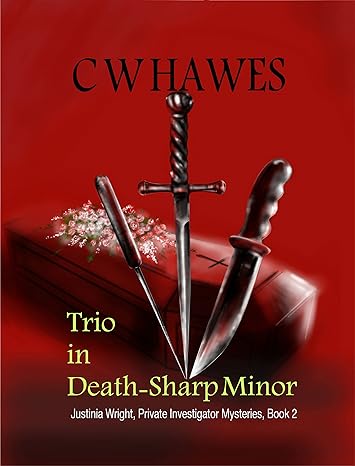
Trio in Death-Sharp Minor
But Jesus Never Wept
The Conspiracy Game

I love Tina and Harry Wright. They were my first children, so to speak. They came into being in the early 1980s, and have been with me ever since. 

What’s more, I really, truly love writing up their crime-busting adventures. Perhaps more than anything else I write.

These books aren’t thrillers in the modern use of that term. The style harkens back to the Golden Age of detective fiction. The era of Nero Wolfe, Hercule Poirot, Miss Marple, Miss Silver, Mr and Mrs North, Roderick Alleyn, and many others too numerous to name.

The pace is somewhat leisurely at the beginning, and gradually increases as the plot thickens, and can become very intense at the climax. Which, quite honestly, I feel is a very natural progression.

Here are snippets of what others think of the series:

“…well written and entertaining, with just enough light humor…”

“Hawes knows how to weave a believable and exciting thriller.”

“Some fictional universes are just places you want to be…”

“A great murder mystery will make a great book, but a deeply developed cast of reoccurring characters is what makes a great series…, and this is a great series.” —Joe Congel, author of the Tony Razzolito, P.I. mysteries

“…well written and plotted. What keeps me coming back to this series is Hawes’ skilled and incremental character development; it allows readers to engage and grow with the stories. … This series starts well and keeps getting better. It is surely one of the best contemporary American mystery series.” —Richard Schwindt, author of the Death in Sioux Lookout trilogy, Tony Price: Confidential trilogy, A Killing in Samana, The Death of Brenda Martin, among others.

For only $2.99, you get 4 super mysteries. That’s only 75¢ each.

But hurry! The sale is only for 139 hours and time flies quickly!

At 10pm PDT on August 15th, the price goes back to $6.99.

Get the Justinia Wright Omnibus now!

Comments are always welcome. And until next time, happy reading!

Share This!
Facebooktwitterpinterest

Who Am I To Talk?

Every now and again I write about writing. Specifically, writing fiction. And some may ask what are my credentials? What gives me the right to give you advice on fiction writing?

Those are good questions. In my years of writing for publication, I have not been on a bestseller list. I’ve garnered some awards for poetry, but not for fiction. And I’ve yet to earn a hundred dollars a month writing fiction.

So what gives me the right to talk to you about fiction writing? What do I know that you don’t?

Derek Doepker talks and writes about Content Curation. You see, we live in an age of information overload. There’s just too much of it out there. How do we know what’s good, bad, and just plain ugly?

Well, that’s where I come in. I curate the content for you. I do so based on my years, many years, of reading and observing other writers, many of them successful, as well as steering you away from the mistakes I’ve made. I sift out the chaff, and present you with the wheat. And I do it for free. I don’t charge you anything for what I share. It is all free to you.

I hadn’t thought of myself as a content curator until Derek Doepker mentioned that being a content curator is one way I can be of service to those folks who subscribe to my mailing list. And if I can do that for my mailing list, I can also do it for readers of my blog.

So who am I to talk? I am a nearly 69-year-old guy who’s been reading about fiction writing for the past 57 or so years. More years than some of you have been breathing. I’ve taken creative writing classes and writing courses. I’ve talked with successful writers and I’ve observed what the moneymaking writers do and don’t do. 

In addition, I have plenty of life experience that helps me to smell out the scam artists. Those folks who are in it just for the money and not to help you. The PT Barnums of the world who believe there is a sucker born every minute, and that sucker may just be you.

I cut out the bull crap for you, because I wish there had been more people to cut out the crap for me.

Remember, my friends, writing is analogous to the gold rush. Just as the ones who made money in the gold rush were not the prospectors, but the ones who sold the shovels, the wagons, and the blue jeans to the prospectors — so to, most of the people who make money in the writing business, are the ones selling advice and software to wannabe authors.

It’s easy in this writing gig to get-poor-quick. In fact, that’s usually what happens. Especially with fiction writing. My goal is to help you not fall into that trap. I don’t want you to be the proof that PT Barnum was right.

One more thing. If you seriously want to make money writing fiction, write non-fiction instead.

Not only is there a much, much better chance of making money writing non-fiction, but if you get sufficiently well-known — people will buy anything you write. That’s what happened to a late friend of mine.

Comments are always welcome. And until next time, happy reading and writing!

Share This!
Facebooktwitterpinterest

Book Review: Last Deadly Lie

Ever since I was a kid, I’ve preferred the series over the standalone book. I read fiction because of the characters, I don’t give two hoots about the plot. Because if the characters are good, they’ll make any plot, or even no plot, work.

Nevertheless, every once in a while I do pick up a standalone novel or story and give it a read.

That’s what happened with Last Deadly Lie by Caleb Pirtle III. I like Mr Pirtle’s writing, the word pictures he draws, and I like his characters. So even though a standalone, I bought a copy of Last Deadly Lie. And I’m glad I did. (You can get it on Amazon.)

What I found was a tour-de-force of contemporary Southern Gothic. Now you might be asking, What the heck is Southern Gothic?

The sub-genre of Southern Gothic is uniquely American, and is a regionalized version of American Gothic. It is a literary attempt to deal with the issues of Southern culture that continue to this day from the Confederacy’s defeat in the War Between the States (Civil War is a misnomer because the South never wanted to take control of the Federal government, which is what a civil war is all about — they wanted to withdraw and be left alone).

Southern Gothic uses the themes of American Gothic not merely for suspense, but to explore the values of the South.

Using the setting of a church and its community in a smallish Southern town, Mr Pirtle gives us an explosive tale that is dark in mood, and filled with corruption, power struggles, overweening pride, and lies. Lots of deep, dark, and often desperate, lies. 

Last Deadly Lie is a novel that becomes a mirror and forces us to look at ourselves, to take a long, deep, and honest look, and say, But for the grace of God go I. Then, again, maybe we can’t say that. Maybe we all, like those accusers of the woman caught in the very act of adultery, just have to slink away, tossing our stone to the ground.

Mr Pirtle has given us a suspense-filled novel that will keep us up past our bedtimes, forgetting about the baseball game and the vacuum cleaner, and will make us forget our dinners until they get cold.

Last Deadly Lie is one of the best novels I’ve read in a very long time. And that’s due to the life-like characters, placed in real-life situations, and Mr Pirtle’s magical way with words that stimulates the imagination to do what no movie or TV show can.

Seven months into the year, and Last Deadly Lie is still the book to beat for my best read of 2021.

Pick up a copy. You won’t be sorry.

Get Last Deadly Lie Here!

Comments are always welcome. And until next time, happy reading!

Share This!
Facebooktwitterpinterest